
Is TABC Certification Required in Texas? Safe Harbor, Explained
Bartending soon? Get certified tonight.
TABC-approved seller-server training in about two hours on your phone, certificate ready the moment you pass.
Quick answer
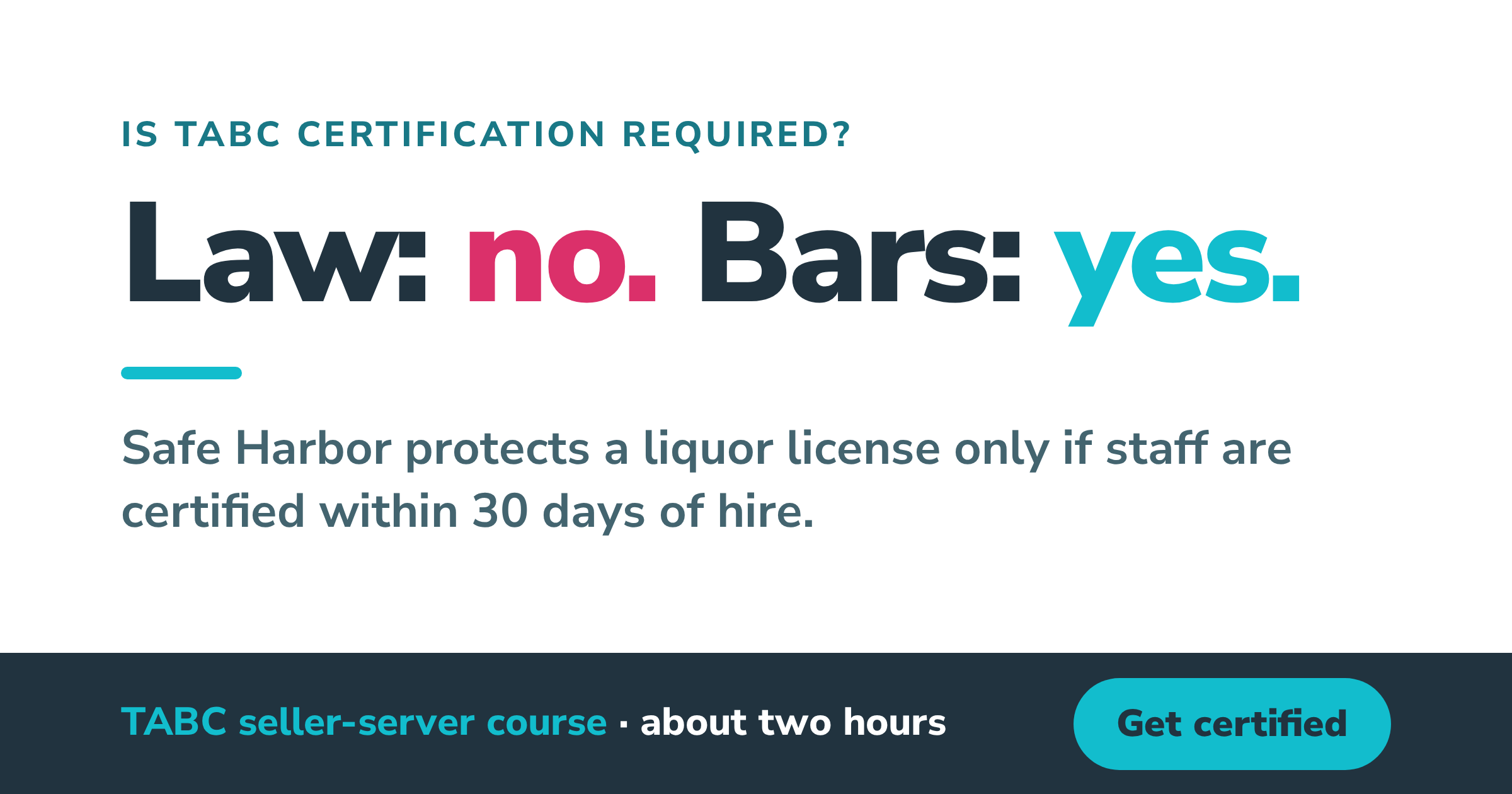
- By law: no. TABC says there is no requirement to be certified under state law.
- By employers: yes. Safe Harbor protects a business from action against its license only if every employee who sells, serves, or delivers alcohol, and their immediate managers, is certified within 30 days of hire.
- Bottom line: get certified before your first shift. It is valid for two years.
Ask ten servers whether TABC certification is required in Texas and you will get ten confident answers, most of them wrong in one direction or the other. The honest answer has two parts, and both matter.
Part one: the law does not require it
The Texas Alcoholic Beverage Commission says so directly in its certification FAQ: there is no requirement to be certified under state law. You will not be fined for pouring a beer without a certificate. So why does every job posting demand one?
Part two: Safe Harbor makes it required anyway
When an employee sells or serves alcohol to a minor or to someone who is already intoxicated, the business's license or permit is exposed to administrative action. Safe Harbor is the provision that protects the business from that penalty. The protection applies only when certain standards are met, and the standards are the whole story:
- The person who made the sale holds a current seller-server certificate from a TABC-approved school.
- Every employee who sells, serves, or delivers alcohol, and their immediate managers, is certified within 30 days of their hire date.
- The employer has not directly or indirectly encouraged the employee to break the law.
Read that second bullet again. One uncertified bartender on day 31 can void the protection for the whole business. That is why "TABC certified" is in the job posting, why managers ask on day one, and why the state's own agency strongly recommends certification even though it does not mandate it.
What this means for you
- Job hunting: walk in certified. It removes the one paperwork reason a manager has to pick someone else.
- Already hired: you have 30 days from your start date before your employer's protection depends on you. Most managers want it before your first shift.
- Working a register: cashiers who ring up alcohol count as sellers. So do delivery drivers carrying alcohol-to-go.
- Managing people: immediate managers are in the rule too. Your own certificate matters as much as your staff's.
How long it lasts and how employers check
Certification is valid for two years from the issue date. Employers verify it through TABC's own certificate inquiry system, which lists your certificate about 14 calendar days after you finish. In the meantime, the dated certificate you downloaded from your school is your proof, and it is what managers accept.
The age question
Safe Harbor is about certification. Age is a separate rule. Employees at bars and restaurants must be 18 or older to serve or handle alcohol, and package store employees must be 21. Grocery and convenience stores have no TABC age restriction, which is why teenage cashiers who scan beer count as sellers under Safe Harbor.
Food too?
If you also touch food, you need a food handler card as well, and that one is required by law within 30 days. Most servers and bartenders end up with both. The accredited food handler course is about an hour, so the pair fits in one evening. Heading behind the bar? Texas issues no bartending license, so TABC certification is the credential.
Why the law is written this way
Texas could have made seller-server certification mandatory for every individual. Instead it made the business responsible and gave the business a way to protect itself. The logic is that the license holder controls hiring, training, and scheduling, so the license holder is the one who should carry the incentive. Safe Harbor turns training into insurance: certify everyone, do not encourage violations, and the business is protected from administrative action when an employee makes a mistake despite the training. Skip the training and the business absorbs the full penalty for every illegal sale. Faced with that math, almost every license holder in the state requires certification.
Who counts as a seller under Safe Harbor
The rule covers every employee who sells, serves, or delivers alcohol, plus their immediate managers. In practice that reaches further than the bar.
- Bartenders and servers at bars and restaurants.
- Cashiers at grocery, convenience, and liquor stores who ring up alcohol.
- Delivery drivers carrying alcohol to go.
- Stadium, venue, and event staff pouring at a licensed location.
- Shift leads and managers who supervise any of the above.
The people it does not reach are those who never touch a transaction or a drink: cooks, dishwashers, a host who only seats guests, a stocker who never works a register. Those roles may still need a food handler card, but Safe Harbor is not their problem.
What "encouraged" means in the third condition
The first two conditions are paperwork. The third is behavior. Safe Harbor protection is lost if the employer directly or indirectly encouraged the employee to violate the law. Direct encouragement is obvious. Indirect encouragement is the interesting part: sales targets that punish refusals, a manager who overrides a bartender's decision to cut someone off, a culture where checking IDs is treated as slowing down the line. The training you receive is partly there to make sure you know what the law expects, so that when a manager pushes, you have something to point to.
The 30 day clock in practice
Safe Harbor requires certification within 30 days of the hire date. That is the legal outer bound. Two practical notes. First, it is 30 days to be certified, meaning to have completed an approved course and hold a dated certificate, not 30 days to appear in TABC's database, which takes about two weeks after completion. Second, most employers will not wait. Expect to be asked for the certificate at your interview or before your first shift, because a manager scheduling an uncertified server is quietly betting the liquor license on nothing going wrong for a month.
The practical takeaway
The state does not require you to be certified. Your employer almost certainly does, and for a good reason. Take the seller-server course before the 30 days are up, and preferably before your first shift.
Frequently asked questions
Is TABC certification required by law in Texas?
No. TABC's own certification FAQ says there is no requirement to be certified under state law. It is required by nearly every employer because of Safe Harbor.
What is Safe Harbor in Texas?
A provision that protects a business's alcohol license or permit from administrative action when an employee makes an illegal sale, as long as the seller was certified by a TABC approved school, every seller and their immediate managers were certified within 30 days of hire, and the employer did not encourage the violation.
How long do I have to get TABC certified after being hired?
Safe Harbor requires certification within 30 days of the hire date. Most employers want it before your first shift.
Do cashiers need TABC certification?
If they ring up alcohol, they count as sellers under Safe Harbor, so employers generally require it. Grocery and convenience stores set no TABC age minimum for cashiers, so this applies to teenage employees too.
Do managers need TABC certification?
Yes. Safe Harbor covers immediate managers of employees who sell, serve, or deliver alcohol, so a manager's own certificate matters as much as the staff's.
How long is TABC certification valid?
Two years from the issue date. To renew, you take an approved course again.
Certified before the 30 days are up.
TABC-approved seller-server training, about two hours on your phone, certificate ready the moment you pass.