
Who Needs a Food Handler Card in Texas?
Card in hand tonight, not on day 29.
The accredited course runs about an hour on your phone, and your certificate downloads the moment you pass. Text it to your manager before your next shift.
Quick answer
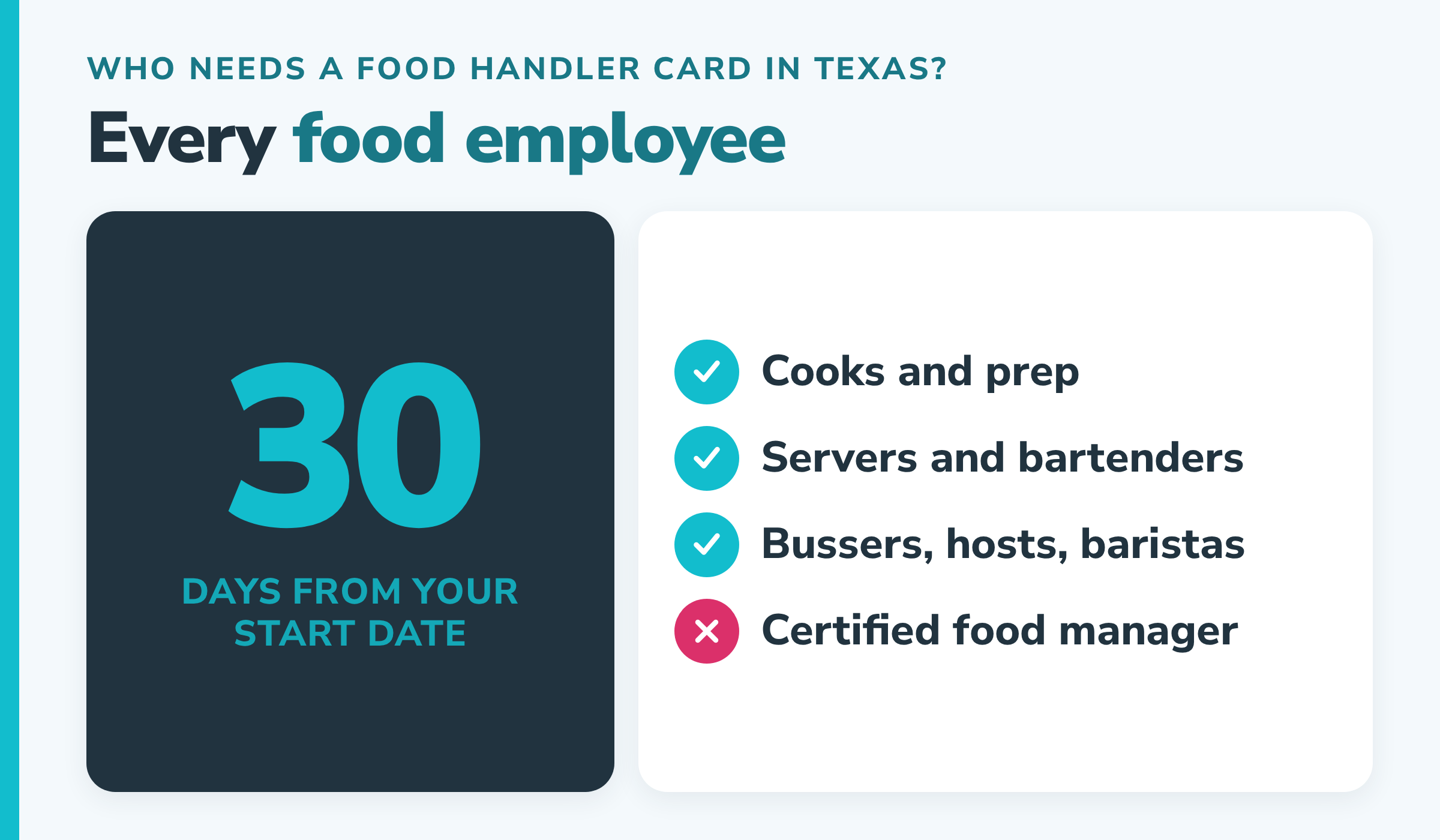
- Who: every food employee, meaning anyone who works with unpackaged food, utensils, or food contact surfaces. Cooks, servers, bartenders, bussers, hosts who roll silverware, baristas.
- When: within 30 days of your start date. Your employer keeps the certificate on file.
- Exempt: the certified food protection manager and workers at temporary food establishments.
If you just got hired anywhere food is prepared or served in Texas, the short answer is probably yes. The longer answer is worth two minutes, because the rule is broader than most people expect and the clock is shorter than most job postings say.
The rule in one sentence
Under the Texas Food Establishment Rules, every food employee, except the certified food protection manager, must successfully complete an accredited food handler training course within 30 days of employment. That is the language in the state FAQ, and it applies to every city and county in Texas.
Two words in that sentence do all the work: food employee and 30 days.
Who counts as a food employee
The state defines a food employee as anyone working with unpackaged food, food equipment or utensils, or food-contact surfaces. Notice that it says nothing about job titles. In a real restaurant that covers:
- Line cooks, prep cooks, and anyone on the grill or fryer
- Servers who carry plates, refill drinks, or garnish anything
- Bartenders, because cutting limes and handling glassware is food contact
- Bussers and dishwashers handling utensils and plates
- Hosts who roll silverware or plate desserts at the end of a shift
- Baristas, deli counter staff, food truck crews, and school and hospital cafeteria workers
If you touch the food, the tools, or the surfaces the food sits on, you are in.
Who is exempt
Two groups. The certified food protection manager, who holds a different and bigger credential, does not also need a handler card under the rule. And the rule does not apply to temporary food establishments, the kind that pop up for a festival or a weekend event. The manager credential is covered further down.
The 30-day clock
You have 30 days from your start date, and your employer is required to keep a certificate of completion on the premises for every food employee. That second part is why managers push you to finish before your first shift rather than on day 29: an inspector can ask for the file at any time.
You will see 60 days quoted on plenty of websites. The current rule text says 30. Plan to 30.
What the card actually is
People call it a food handlers license, permit, certificate, or card. Same thing. It is proof you completed an accredited course covering the six required topics, and it is good until the expiration date printed on it, typically two years. One card works everywhere in Texas since state law took local card requirements off the table. If you earned a card in another state, check its accreditation before assuming it transfers; the section below explains what to look for.
Working with alcohol too?
Servers and bartenders usually need this card and a TABC seller-server certification, which is a separate credential from a separate agency. The food handler card is required by law for anyone touching food. TABC certification is not required by law, but nearly every employer requires it within 30 days because it protects the business under a rule called Safe Harbor. If your job involves both plates and drinks, plan on both. The seller-server course takes about two hours and can be done the same evening.
Job by job: do you need a Texas food handler card?
The definition is about what you touch, not what your badge says. Here is how it plays out across the jobs people actually ask about.
- Cook, prep cook, grill, fryer: yes. This is the center of the rule.
- Server: yes. Carrying plates, refilling drinks, and adding a garnish are all food contact.
- Bartender: yes. Cutting fruit, handling glassware, and serving bar snacks all count, even at a bar with no kitchen.
- Busser or dishwasher: yes. Utensils and plates are food contact surfaces.
- Host: usually. If you roll silverware, plate a dessert, or box leftovers, yes. If you only seat guests, the rule may not reach you, but most restaurants ask for the card anyway so they can move you between stations.
- Barista: yes. Milk, syrups, pastries, and cups are all in scope.
- Deli, bakery, or hot food counter at a grocery store: yes.
- Grocery cashier who only scans packaged goods: generally no. The rule is about unpackaged food.
- Food truck crew: yes, everyone on the truck who handles food.
- School, hospital, or corporate cafeteria staff: yes. The rule covers food establishments, not just restaurants.
- Delivery driver carrying sealed bags: generally no, unless you also handle unpackaged food in the kitchen.
What about managers?
Texas has a second, bigger credential called the certified food protection manager. State rule says every establishment needs at least one person with supervisory authority over food prep who holds it, and that person is the one food employee who does not also need a handler card. Everyone else on the team still does. If you are a shift lead who directs food prep, you likely need the handler card now and the manager credential if you become the designated person in charge. The manager credential is earned by passing a separate exam and is valid for five years, compared with two years for the handler card.
Out of state and national cards
Texas recognizes two kinds of food handler training: a course accredited by the state health department and listed on its registry, or a course accredited by ANSI. If your card from another state came from an ANSI accredited program, it transfers. If it came from a state specific program with no ANSI mark, it does not, and the 30 day clock starts on your first day at the Texas job. Look for the accreditation mark on the certificate itself before you assume anything.
What your employer has to do
The rule puts obligations on both sides. You have to complete the course within 30 days. Your employer has to keep a certificate of completion on the premises for every food employee and produce it when an inspector asks. That is why the manager who hired you is pushing for the card before your first shift rather than treating 30 days as a deadline. From their side, an expired or missing card in the file during an inspection is a problem they would rather not explain.
What to do next
If you were hired to work anywhere food is prepared or served in Texas, assume the rule applies to you and start the clock at zero rather than 30. The accredited food handler course runs about an hour on your phone, and your certificate downloads the moment you pass.
Frequently asked questions
Do you need a food handler card to work in Texas?
If you work with unpackaged food, food equipment or utensils, or food contact surfaces, yes. State rule requires every food employee except the certified food protection manager to complete an accredited food handler course within 30 days of employment.
How long do you have to get a food handler card in Texas?
30 days from your start date. Many websites still quote 60 days from an older version of the rule. The current rule says 30, and your manager will likely want it before your first shift.
Who is exempt from the Texas food handler requirement?
Two groups: the certified food protection manager, who holds a different and bigger credential, and workers at temporary food establishments such as festival and event booths.
Is a food handler card the same as a food handler permit or license?
Yes. People use card, certificate, permit, and license interchangeably. They all refer to the certificate of completion from an accredited course.
Do I need a food handler card if I am under 18?
Yes, if you do the work. There is no age minimum for the food handler card, which makes it the natural first credential for a first job.
Does my employer pay for my food handler card?
Some do and some do not. The rule requires you to have the card and requires your employer to keep it on file. Who pays is between you and the restaurant.
One card, every kitchen in Texas.
Accredited course, about two hours, certificate the moment you pass. Valid in all 254 counties for two years.