
TABC vs. Food Handlers: Which Certification Do You Need?
Need both? Start with the card tonight.
The accredited food handler course is about an hour on your phone, and TABC seller-server training is about two. Certificates download the moment you pass.
Quick answer
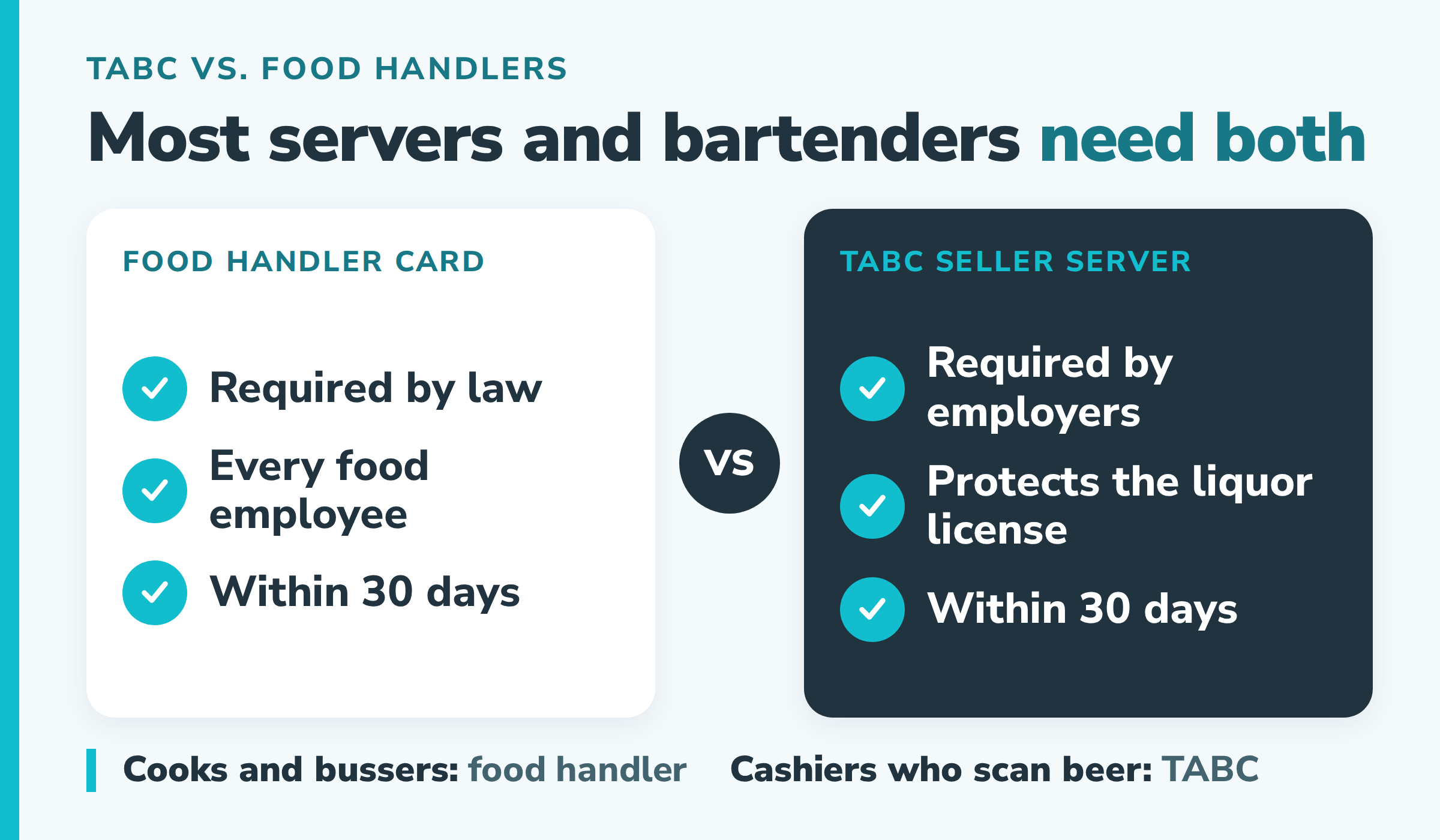
- Food handler card: required by law for every food employee within 30 days. Covers hygiene, contamination, temperatures, and allergens.
- TABC seller-server: not required by law, but required by nearly every employer because Safe Harbor protects the liquor license only if staff are certified within 30 days.
- Who needs both: servers and bartenders. Cooks and bussers need the card; cashiers who scan alcohol need TABC.
Two different state agencies, two different certifications, one very common question. If you are about to start a restaurant, bar, or retail job in Texas, here is how to tell which one you need, in plain terms.
The two certifications, side by side
The food handler card comes from the food safety side of state government. It is required by law: every food employee has to finish an accredited course within 30 days of starting, and the employer keeps the certificate on file. It covers hygiene, contamination, time and temperature, and allergens.
TABC seller-server certification comes from the Texas Alcoholic Beverage Commission. It is not required by state law, and TABC says so directly in its certification FAQ. It is required by almost every employer anyway, for a reason called Safe Harbor: if every employee who sells, serves, or delivers alcohol, and their immediate managers, is certified within 30 days of hire, the business's liquor license is protected when an employee makes an illegal sale. No certification, no protection. It covers checking IDs, spotting intoxication, refusing sales, and the law around minors.
Both are valid for two years. Neither substitutes for the other.
Which one does your job need?
- Server or waitstaff: both. You carry food and you carry drinks.
- Bartender: both. Garnishes, glassware, and bar snacks are food contact, and pouring is the TABC side.
- Line cook, prep, dishwasher, busser: food handler card. You touch food, utensils, and surfaces, and you never ring up a drink.
- Grocery or convenience cashier who scans beer: TABC. Add the food handler card if you also work a deli or hot food counter.
- Delivery driver carrying alcohol-to-go: TABC. Add the card if you handle unpackaged food.
- Host: food handler card if you roll silverware or plate anything. Neither if you only seat guests, though many restaurants ask for the card anyway.
- Manager or shift lead: TABC counts you too, since Safe Harbor covers immediate managers. On the food side you may also need the bigger certified food manager credential if you are the designated person in charge.
One age wrinkle on the alcohol side. TABC's age rules require employees at bars and restaurants to be 18 or older to prepare, serve, or handle alcohol. Someone under 18 can run a register where alcohol is sold as long as an adult employee handles the drinks. The food handler card has no age minimum.
Why most people end up with both
Restaurant jobs rarely stay in one lane. The busser gets asked to run drinks. The cook covers the bar on a slow Tuesday. The cashier picks up deli shifts. Managers know this, which is why job postings for front-of-house roles list both certifications even when the role technically needs one. Walking in with both makes you the easy hire.
They also expire on the same two-year cycle, so finishing them together means one renewal date.
Where to start
If you only need the card, the food handler course is about an hour. If you only need TABC, seller-server certification is about two. If you need both, do them the same evening and you will have one renewal date to track. Bartenders wondering about a separate license can stop wondering: Texas does not issue a bartending license. TABC certification is the credential.
What each course actually teaches
People assume the two courses overlap. They barely touch.
Food handler
The six required topics, set by state rule: foodborne illness outbreaks, good hygiene, preventing contamination by employees, cross contamination, time and temperature, and allergen awareness. It is about keeping food from making people sick. There is nothing in it about alcohol.
TABC seller-server
Checking identification and spotting fake IDs, recognizing the signs of intoxication, how and when to refuse a sale, the laws around minors and alcohol, and what happens to the employee and the business when an illegal sale occurs. It is about keeping alcohol away from the people the law says cannot have it. There is nothing in it about handwashing.
That is why neither substitutes for the other. A server who has one and not the other is trained for half the job.
Who is on the hook if you are missing one
The two credentials also carry different kinds of risk, which explains why managers care about both.
- Missing food handler card: a compliance problem for the establishment. The rule requires your employer to keep a certificate on file for every food employee, and an inspector can ask for the file at any time.
- Missing TABC certification: a liquor license problem. Safe Harbor protects the business only if every employee who sells, serves, or delivers alcohol is certified within 30 days of hire. One uncertified employee can remove that protection for everyone.
Neither is a fine you pay personally, but both are reasons a manager will not put you on the schedule.
The two agencies, briefly
The food handler card lives with the state health agency, which accredits training programs and publishes the rules for food establishments. TABC seller-server certification lives with the Texas Alcoholic Beverage Commission, which approves schools, runs the certificate lookup that employers use, and enforces the alcohol code. Different agencies, different rulebooks, different databases. Nothing you do with one shows up in the other.
Which one to start with
Food handler for anyone who touches food. TABC for anyone who sells or serves alcohol. Both for the people who do both, which in a restaurant is most of the front of house. Start with the accredited food handler course, then the seller-server course, and walk into your first shift with nothing left for a manager to ask about.
Frequently asked questions
Do I need both TABC and a food handler card in Texas?
If your job involves both food and alcohol, yes. Servers and bartenders almost always need both. Kitchen staff who never handle a drink need only the food handler card, and cashiers who scan alcohol but never touch unpackaged food need only TABC.
Is TABC certification the same as a food handler card?
No. TABC seller-server certification covers alcohol sales and service and comes from the Texas Alcoholic Beverage Commission. The food handler card covers food safety and comes from the state health side. They are separate courses, separate certificates, and separate renewals.
Which one is required by law?
The food handler card. Every food employee must complete an accredited course within 30 days. TABC certification is not required by state law, but Safe Harbor makes it effectively mandatory at almost every bar, restaurant, and store that sells alcohol.
How long does each certification last?
Both are valid for two years. The food handler card is valid until the date printed on it, and TABC certification is valid for two years from the issue date.
Which should I get first?
If you only have one evening, get whichever your manager asked about first. If you have a choice, the food handler card is the one required by law and has no age minimum, so it is usually the safer first move.
Can I get both in one night?
Yes. The food handler course is about an hour and TABC seller-server training is about two. Both certificates download when you pass.
One card, every kitchen in Texas.
Accredited course, about two hours, certificate the moment you pass. Valid in all 254 counties for two years.