
Will a National Food Handler Card Work in Texas?
Not sure your card counts? Get one that does.
State-accredited Texas food handler course, about an hour on your phone, certificate valid in every Texas county.
Quick answer
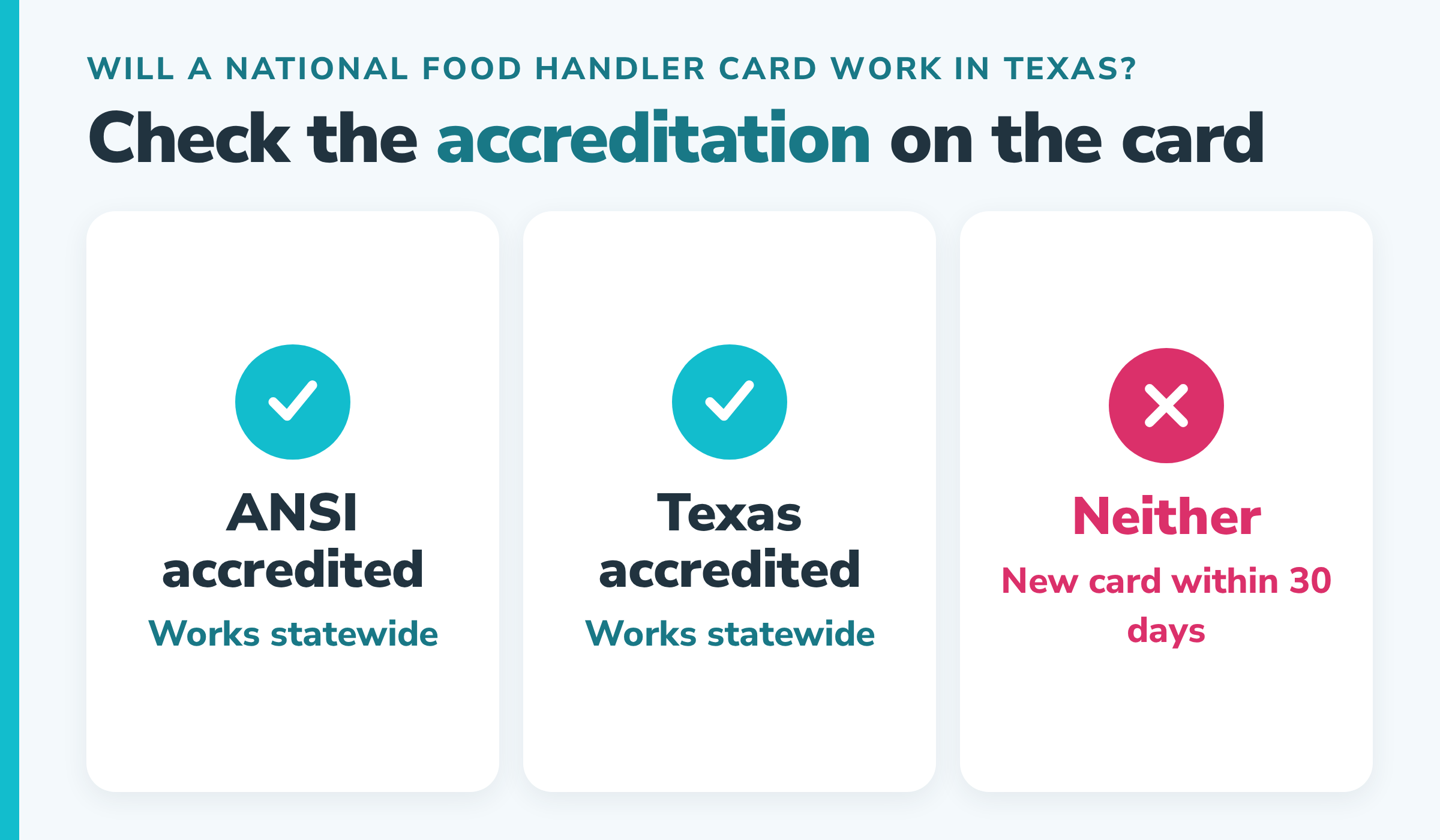
- Yes, if it is accredited: Texas accepts cards from ANSI accredited national programs and from programs accredited by the state health department.
- If it is not: the card has no statewide recognition, and you need an accredited course within 30 days of starting your Texas job.
- How to check: look for the ANSI or ANAB mark with a program number, or a Texas program license number, on the certificate itself.
Short answer: yes, if the program that issued it is accredited by ANSI. If it is not, Texas does not have to accept it, no matter how official the card looks.
What the law actually says
Texas recognizes two kinds of food handler training. The first is a course accredited by the state health department and listed on its registry. The second is a course accredited by the American National Standards Institute, usually written as ANSI or ANAB on the certificate. Under state law, a worker trained in either kind is considered to have met every local health jurisdiction's training, testing, and permitting requirements. The state FAQ puts it plainly: cards from ANSI-accredited programs get statewide recognition.
Which means a national card from an ANSI-accredited provider works in Austin, Houston, Lubbock, and every county in between.
What about a card from another state?
Same test. If the out-of-state program is ANSI-accredited, your card transfers. If it is a state-specific program from somewhere else with no ANSI accreditation, it does not have statewide reciprocity in Texas, and you will need a new one within 30 days of starting your Texas job.
How to check the card you already have
- Look at the certificate itself. Accredited programs print their accreditation on it, typically an ANSI or ANAB mark with a program number, or a Texas program license number.
- Check the provider's website for the same mark. If you cannot find it in either place, assume the card is not accredited.
- Check the expiration date. Even an accredited card is no good once it lapses, and renewing means taking an accredited course again.
Can a city still make you get a local card?
No. State law bars local health jurisdictions from charging a fee or requiring their own food handler card when you hold an accredited certificate, and SB 1008 reinforced state authority over the food service industry. If a job posting still mentions a city card, it is out of date. One accredited card covers the whole state.
Which kind should you get if you are starting fresh?
If you plan to stay in Texas, a state-accredited course is the direct route and covers the same six topics every accredited course must teach. If you expect to work in other states, an ANSI-accredited course travels better. Either way, the course is about an hour and the certificate downloads when you pass.
The alcohol side does not transfer
This is where people get burned. TABC seller-server certification is Texas-only, and Safe Harbor protection for your employer depends on a certificate from a TABC-approved school. National alcohol server programs do not count for that purpose. If your job involves pouring or selling drinks, plan on the Texas seller-server course no matter where you were certified before.
ANSI, ANAB, and what the letters mean
The American National Standards Institute accredits organizations that certify people, including food handler training providers. The accreditation arm is called the ANSI National Accreditation Board, which is why you will see ANSI on some certificates and ANAB on others. They refer to the same accreditation. For Texas purposes, either mark on a food handler certificate means the program meets the standard that state law recognizes, and the card is good statewide.
What ANSI does not do is issue cards. If a certificate says "ANSI approved" with no program name or number, be suspicious. Real accredited programs print their own name alongside the accreditation mark.
Common situations, sorted
- You moved from another state with an ANSI-accredited card. It works. Send a copy to your new employer and note the expiration date.
- You moved with a state-specific card and no ANSI mark. It does not carry reciprocity in Texas. You have 30 days from your start date to complete an accredited course.
- You took a national online course while living in Texas. Same test as above. If the program is ANSI accredited, you are covered. If not, you need an accredited course.
- You have a Texas card from years ago and moved back. Check the date. If it has not expired, it is still good. If it has, take an accredited course again.
- You have a certified food manager credential from another state. That is a different credential with its own rules. Texas accepts a national ANSI-certified food manager exam, but the manager credential does not replace a handler card for the rest of the staff.
Why unaccredited cards still exist
Nothing stops a website from selling a "food safety certificate" that is not accredited by anyone. Some are honest about being informational. Others look official on purpose. The tell is always the same: no accreditation mark, no program number, no way to verify the provider on the state registry or the ANSI directory. A manager who accepts one of these is taking a risk during an inspection, which is why most managers will not, and why it is worth checking before you pay rather than after.
The Texas side of the choice
If you are getting certified for the first time and plan to work in Texas, a course accredited by the state health department is the direct route. It teaches the six topics state rule requires, the certificate carries a Texas program license number that any Texas manager will recognize, and it is good in every county. The main reason to prefer an ANSI-accredited course is portability if you expect to work in other states soon. Both are recognized here.
If you are still not sure
Accreditation is the whole question. If your national card carries an ANSI or ANAB mark, it works in every Texas county. If it does not, or you are not sure, the accredited food handler course takes about an hour and removes the doubt.
Frequently asked questions
Does Texas accept a national food handler card?
Yes, if the program that issued it is ANSI accredited. State law treats a worker trained by an ANSI-accredited program as having met every local training, testing, and permitting requirement in Texas.
Is my out-of-state food handler card valid in Texas?
Only if the program is ANSI accredited. A state-specific card from another state with no ANSI accreditation does not have reciprocity in Texas, and you will need an accredited course within 30 days of starting work.
How do I know if my food handler card is accredited?
Look at the certificate for an ANSI or ANAB mark with a program number, or a Texas program license number. Then confirm the same mark on the provider's website. If you cannot find it in either place, assume it is not accredited.
Can a Texas city require its own food handler card?
No. State law prohibits local health jurisdictions from requiring or issuing their own card or charging a fee when you hold a certificate from an accredited program.
Does my TABC certification transfer from another state?
No. TABC seller-server certification is Texas only, and an employer's Safe Harbor protection depends on a certificate from a TABC-approved school. National alcohol server programs do not count for that purpose.
Should I get a Texas-accredited or an ANSI-accredited course?
Both are recognized in Texas. If you plan to stay, a Texas-accredited course is the direct route. If you expect to work in other states, an ANSI-accredited course travels better.
One card, every kitchen in Texas.
Accredited course, about two hours, certificate the moment you pass. Valid in all 254 counties for two years.